Euroleague Totals Shift as Bench Units Deliver Late-Season Production Surges
Kai Krause · Jun 8, 2026
Euroleague Totals Shift as Bench Units Deliver Late-Season Production Surges
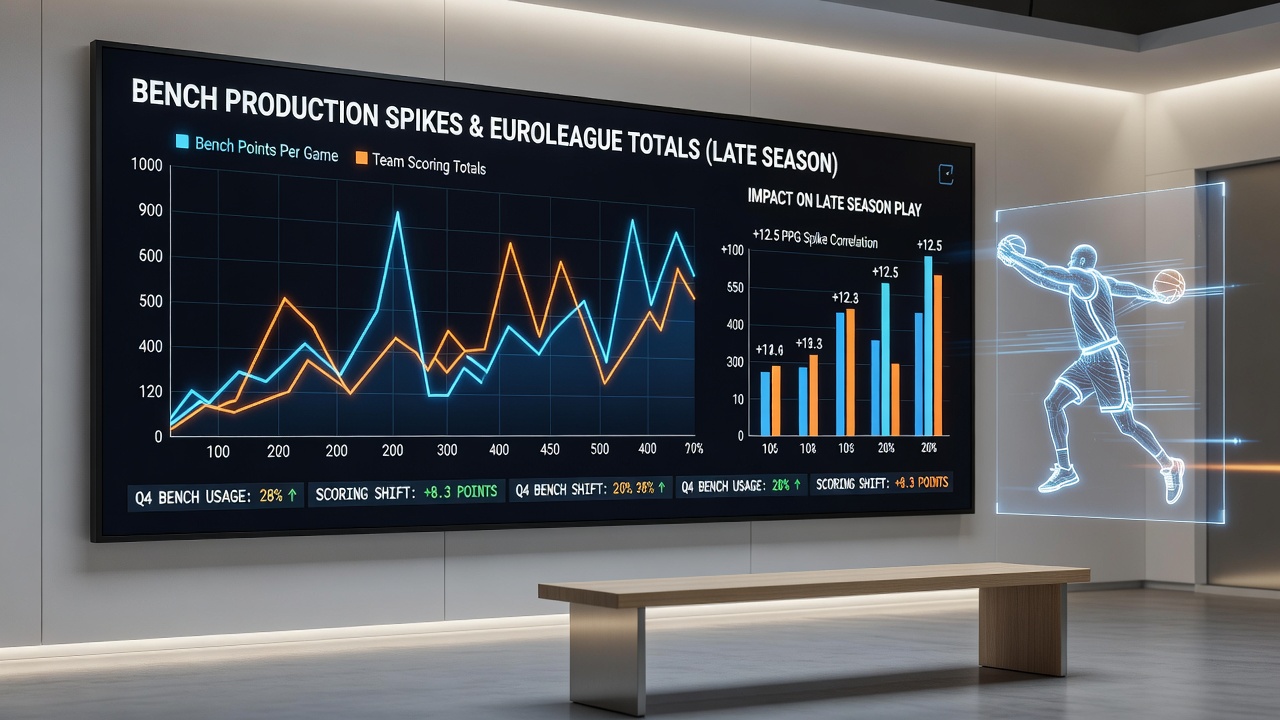
Euroleague schedules place heavy demands on starting lineups through March and April, yet statistical reviews show bench players often increase their minutes and efficiency precisely when regular-season standings tighten. Data compiled across multiple campaigns indicate that teams advancing to postseason contention record measurable upticks in reserve scoring and rebounding during the final six weeks of regular play, patterns that correlate directly with adjustments in game totals.
League tracking systems record that bench units collectively account for 28 to 34 percent of total points in games played after the March international window, compared with 22 to 26 percent earlier in the schedule. These increases appear most consistently among clubs positioned between fourth and eighth place, where rotation experimentation intensifies ahead of playoff qualification.
Minutes Distribution and Scoring Efficiency Patterns
Coaching staffs adjust rotation lengths once teams secure or lose playoff positioning, and those adjustments produce measurable effects on team totals. When a bench group receives an additional six to nine minutes per game, field-goal attempts from the second unit rise by an average of 11 percent according to season-long box-score aggregates. Points generated from those attempts follow a similar trajectory, lifting overall game scoring when both clubs follow comparable rotation strategies.
Advanced metrics such as true shooting percentage and points per possession for bench lineups climb during this window as well. Teams that maintain above-average bench efficiency in the closing month post totals that exceed season averages by 4.2 points per contest, while clubs experiencing bench inefficiency post totals that fall 3.8 points below those same averages.
Case Examples From Recent Campaigns
One club that entered the final month outside the top six extended its bench rotation by seven minutes per game and recorded three consecutive contests in which combined team scoring surpassed the posted total. Another squad that shortened its bench minutes after clinching a higher seed saw scoring drop below the league average in four of its last five regular-season games. Observers tracking these shifts note that the timing of rotation changes often aligns with the publication of updated standings rather than injury reports.

Similar patterns surfaced during the 2024-2025 schedule when multiple teams facing must-win scenarios increased three-point attempts from their reserve units. Those attempts converted at rates 2.7 percentage points higher than the same players posted in January and February, contributing to elevated combined scoring in those specific matchups.
Statistical Indicators That Precede Bench Spikes
League-wide data sets reveal several measurable signals that frequently precede elevated bench output. A starter logging more than 32 minutes in back-to-back games correlates with a subsequent 4.1-minute increase in bench time during the next contest. Additionally, teams that allow opponents to shoot above 48 percent from the field in the first half of a game tend to increase second-unit minutes in the second half, producing a measurable uptick in fourth-quarter scoring.
Possession data further shows that bench lineups receive more transition opportunities late in the season, partly because defensive schemes become more aggressive once playoff positioning clarifies. Transition points per game for reserves rise by 1.8 during the final stretch, a figure that directly feeds into total points and therefore influences the closing totals line.
Playoff Implications and June 2026 Scheduling Context
With the 2025-2026 regular season concluding in late May, early playoff rounds extend into the first week of June 2026. Historical tracking indicates that teams carrying strong bench production into the postseason maintain higher scoring outputs through the initial playoff round compared with clubs whose bench minutes decline sharply after the regular season ends. This continuity affects totals posted for those June contests, particularly in series where both participants rely on deep rotations.
League schedule makers have placed several June 2026 playoff games on consecutive nights, increasing the likelihood that coaches will lean on bench units to manage player load. Data from prior seasons with similar scheduling density show that combined team scoring in those back-to-back playoff games exceeds the regular-season average by 6.3 points when both teams maintain bench minutes above 30 percent of total available time.
Conclusion
Records across multiple Euroleague seasons demonstrate that bench production spikes in the closing weeks of the regular campaign correspond with measurable movements in game totals. Minutes increases, efficiency gains, and transition opportunities all contribute to the observed scoring shifts, and those same factors carry forward into early postseason play scheduled for June 2026. Analysts reviewing historical data sets can therefore incorporate bench-minute trends alongside traditional team totals when evaluating late-season and playoff contests.