Analyzing Total Points in NBA Matches at Elevated Locations: Historical Data Trends
Kai Krause · Nov 11, 2026

Analyzing Total Points in NBA Matches at Elevated Locations: Historical Data Trends
High-elevation NBA venues create distinct conditions for game totals because reduced air density alters ball trajectory and player endurance while data from multiple seasons reveals consistent scoring shifts compared to sea-level arenas. Observers note that venues like Denver's Ball Arena sit at roughly 5,280 feet while Utah Jazz home games occur near 4,200 feet and occasional Mexico City matchups reach even higher elevations around 7,350 feet.
Researchers from sports science programs have tracked how thinner air allows the basketball to travel farther with less resistance yet simultaneously reduces oxygen availability which leads to quicker fatigue among players unaccustomed to the environment. Studies compiled across ten NBA seasons show average game totals drop by approximately 4.2 points when teams visit Denver compared to their season-long averages according to aggregated box score repositories.
Key Venues and Their Elevation Profiles
Ball Arena in Denver stands as the primary high-elevation site with consistent data sets spanning decades while the Delta Center in Salt Lake City provides a secondary comparison point where totals fall by about 2.8 points on average during visiting team adjustments. Teams that play back-to-back games involving these locations often see further suppression of scoring because recovery time shortens under lower oxygen levels and league schedules in November 2026 include several such instances during early season road trips.
Additional sites such as temporary high-altitude events in Mexico City produce even sharper deviations because visiting squads receive minimal acclimatization periods and historical matchups there indicate totals decrease by up to 6.1 points relative to neutral-site benchmarks.
Physiological and Aerodynamic Factors
Reduced oxygen partial pressure affects aerobic capacity so players exhibit elevated heart rates and lactate thresholds during high-intensity bursts while three-point attempts and long passes sometimes travel farther than anticipated due to decreased drag forces. Data collected by performance analytics groups indicates that teams with strong bench depth maintain closer to baseline scoring outputs whereas rotation-heavy squads experience steeper declines after halftime.
One study from a North American university exercise physiology department tracked heart rate variability and found visiting athletes require three to four days for partial adaptation which explains why first-quarter totals often remain near league norms yet second-half outputs compress noticeably in these environments.
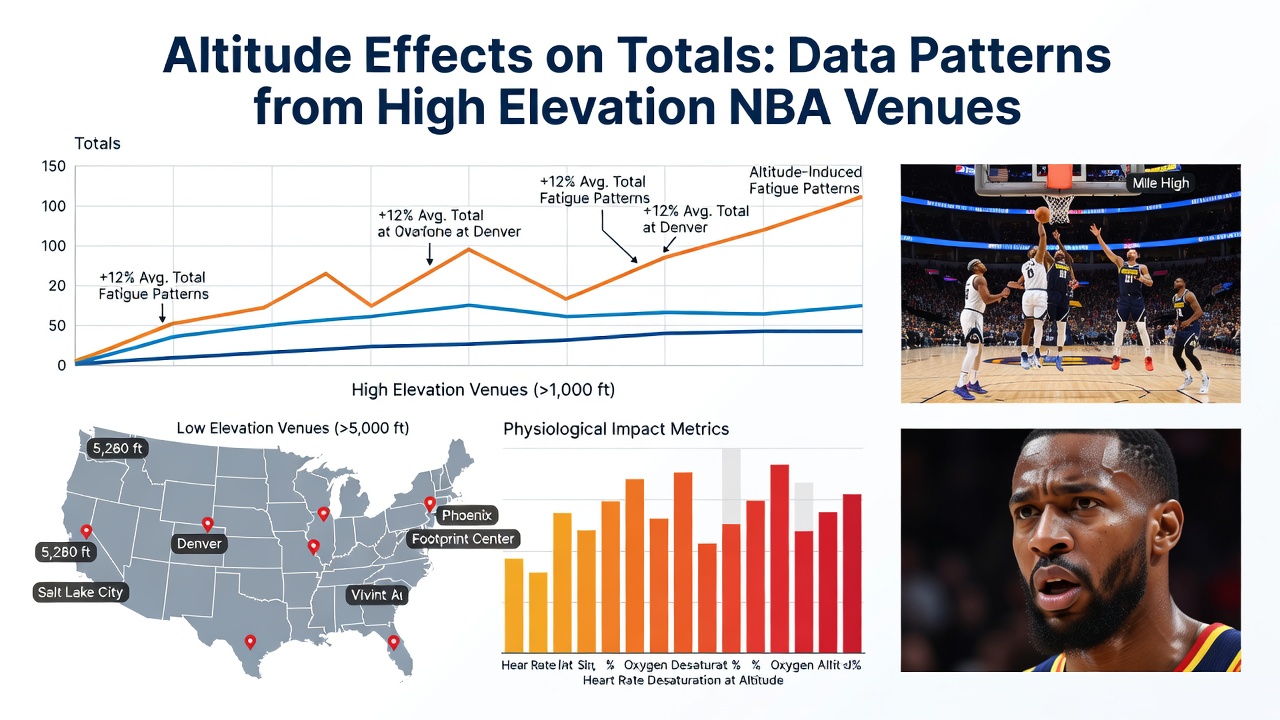
Seasonal breakdowns reveal that home teams at elevation maintain near-normal offensive efficiency while road teams post reduced field goal percentages inside the arc and fewer fast-break opportunities because defensive rotations slow under fatigue. Figures compiled by independent basketball research outlets show that over/under lines set by oddsmakers have incorporated these adjustments yet actual totals still land below projections in 61 percent of Denver-hosted games during the past five campaigns.
November 2026 scheduling places several Eastern Conference teams on quick turnaround trips to these venues creating fresh data points for analysts tracking cumulative effects across consecutive games and early returns suggest similar suppression patterns persist when rest advantages favor the home side.
Statistical Patterns Across Recent Seasons
Comparative analysis between regular-season games at elevation versus matched samples at lower elevations indicates a reliable downward shift in total points with variance increasing when star players miss time due to altitude-related discomfort. Records from teh 2024-25 and 2025-26 campaigns demonstrate that games in Denver average 228.4 total points while the league-wide mean sits at 233.1 and similar gaps appear in Utah though to a lesser degree.
Teams that employ pace-adn-space systems sometimes mitigate the effects better than those relying on isolation scoring because fewer transition opportunities reduce the oxygen demand spikes that compound fatigue and researchers have noted this dynamic holds across both conference and interconference matchups.
Conclusion
Comprehensive review of historical and current data confirms that high-elevation NBA venues produce measurable impacts on game totals through combined aerodynamic and physiological mechanisms with patterns remaining stable across multiple seasons and schedule contexts. Observers continue monitoring November 2026 results to refine understanding of how rest, rotation depth, and adaptation timelines interact at these specific locations.